Letter format


Letter Format
"Always write angry letters to your enemies but never mail them." - J. Fallows
This article covers the conventional letter format. Try creating a few letters from scratch before downloading a template. These are the conventions:
- Heading
- Recipient's Name and Address
- Salutation
- Body
- Closing
- Signature
- Notations
- encls. or enclosures 2: Meaning there are two enclosed documents (e.g., a packing slip and a check).
- attached: Meaning a referenced document is stapled to the letter.
- cc: Followed by a list of names receiving a copy of the letter.
- P.S.

Most businesses use printed letterhead paper, which shows standard corporate information at the top or bottom of the page. Use letterhead for the first page of a letter only. Subsequent pages are printed on blank paper of the same quality.
Whether you use letterhead or not, the information that appears at the top of page one identifies the sender of the letter—name and return address. By convention, this information is placed on the right-hand side of the paper, about mid-width. Place the date below the return address. The date is essential. Please don't leave it out. Most letter senders (or recipients) expect a reply within 30 days.
Envelopes, once opened, are often discarded. Repeat the recipient's name and address on page one of the letter itself. Page one now has a record of whom the letter is intended for, from whom it came, and the date it was written. Remember that letters serve as written records.
Credit Department
Stomping Grounds Software
Suite 303, 2456 Wellington Ave.
New Haven, ON
L3X 2A8
Stomping Grounds Software
Suite 303, 2456 Wellington Ave.
New Haven, ON
L3X 2A8
Attention: Anna Ampleton
The recipient's name can be a person, a department, or both. You can address a letter to a department and use an "attention" line to direct it to a specific person. If you are unsure who should receive your letter, it is best to call the company and ask for clarification. Avoid having your letter sit idle in the wrong person's inbox.
After all the formalities of addressing the letter, the salutation offers an opportunity to make the letter more personal. Use first names only if you are on a first-name basis with the recipient. Otherwise, use full names and titles. Styles include:
Attention: Ms. Anna Ampleton
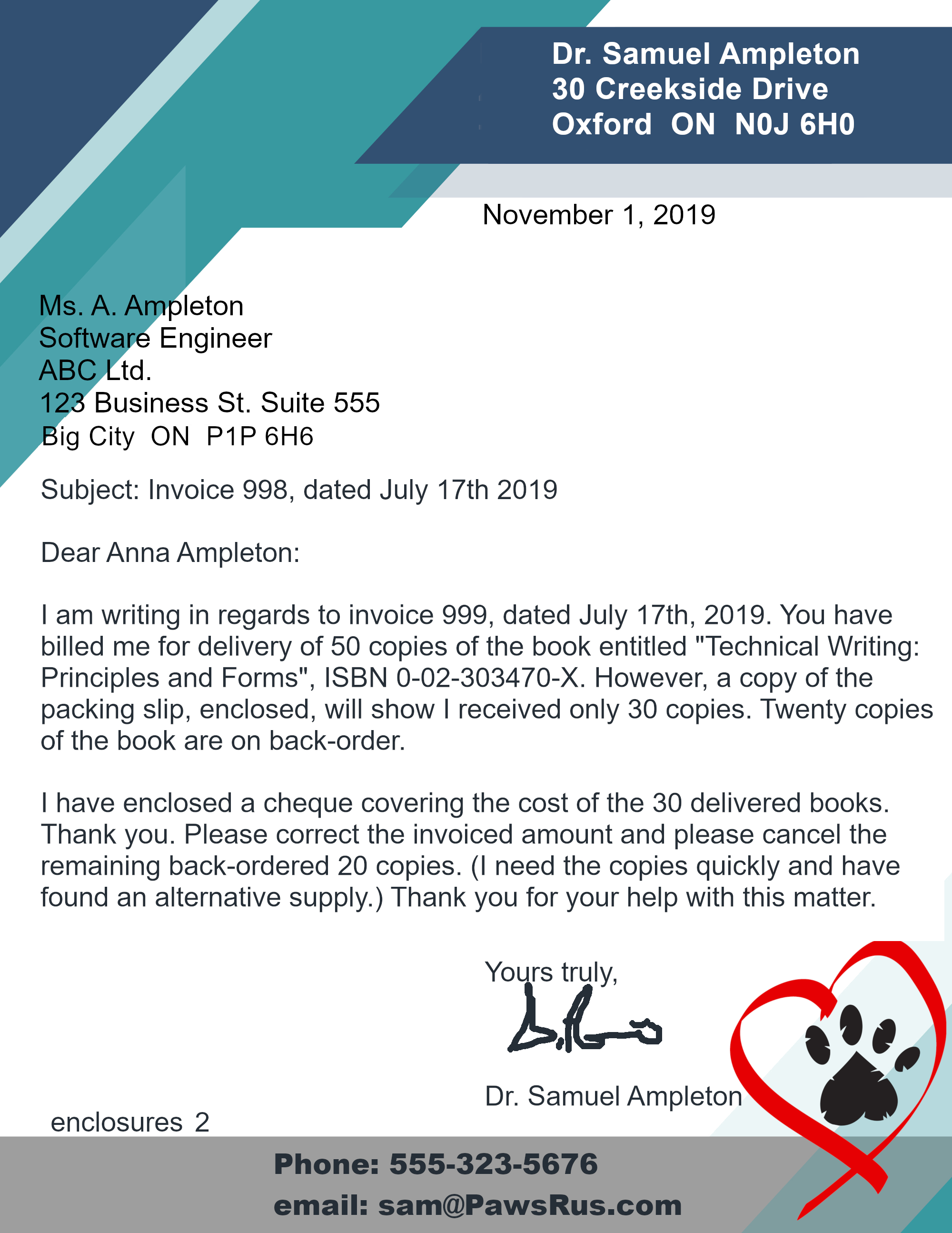
Subject: Invoice 998, dated July 17, 2019
Dear Anna Ampleton:
Re: Invoice 998, dated July 17, 2019
To whom it may concern:
To paraphrase from the referenced textbook: "The body contains the letter's message. The introductory paragraph should quickly gain the reader's attention and reference any prior correspondence. Next, present facts, reasons, and explanations. In the closing paragraph, request what action you expect from the recipient."
Best advice: Get to the point quickly. Stick to the facts. Be polite.
I am writing regarding invoice 999, dated July 17, 2019. You have billed me for delivery of 50 copies of the book Technical Writing: Principles and Forms, ISBN 0-02-303470-X. However, the enclosed packing slip shows that I received only 30 copies. Twenty copies of the book are on back order.
I have enclosed a check covering the cost of the 30 delivered books. Please correct the invoiced amount and cancel the remaining back-ordered 20 copies. Thank you for your help with this matter.
Leave two lines after the last paragraph before the closing. If you omitted the salutation, omit the closing as well. The closing is often placed on the right-hand side of the page, near mid-width, matching the style of the salutation.
Yours very truly,
Very truly yours,
Respectfully yours,
Yours truly,
Sincerely,
Regards,
Leave five blank lines for the signature and type the sender's name below. Use a formal style if required.
Notations appear at the bottom left of the letter and provide additional information such as:
The postscript, if included, appears at the very bottom of the letter. It allows for adding a second thought in a personal letter or drawing attention to one more point in a business letter.
If your letter extends beyond a single page, number subsequent pages in a format such as "Page 2 of 3" and date each page.