Slide 5 Grammar and Composition


One Path. Many Lessons.
Slide 5 of 24: Grammar and Composition
Narration
Reading doesn't have to be the end of the lesson. Learners who are ready can begin looking at how words and sentences are put together — and eventually begin creating something of their own.
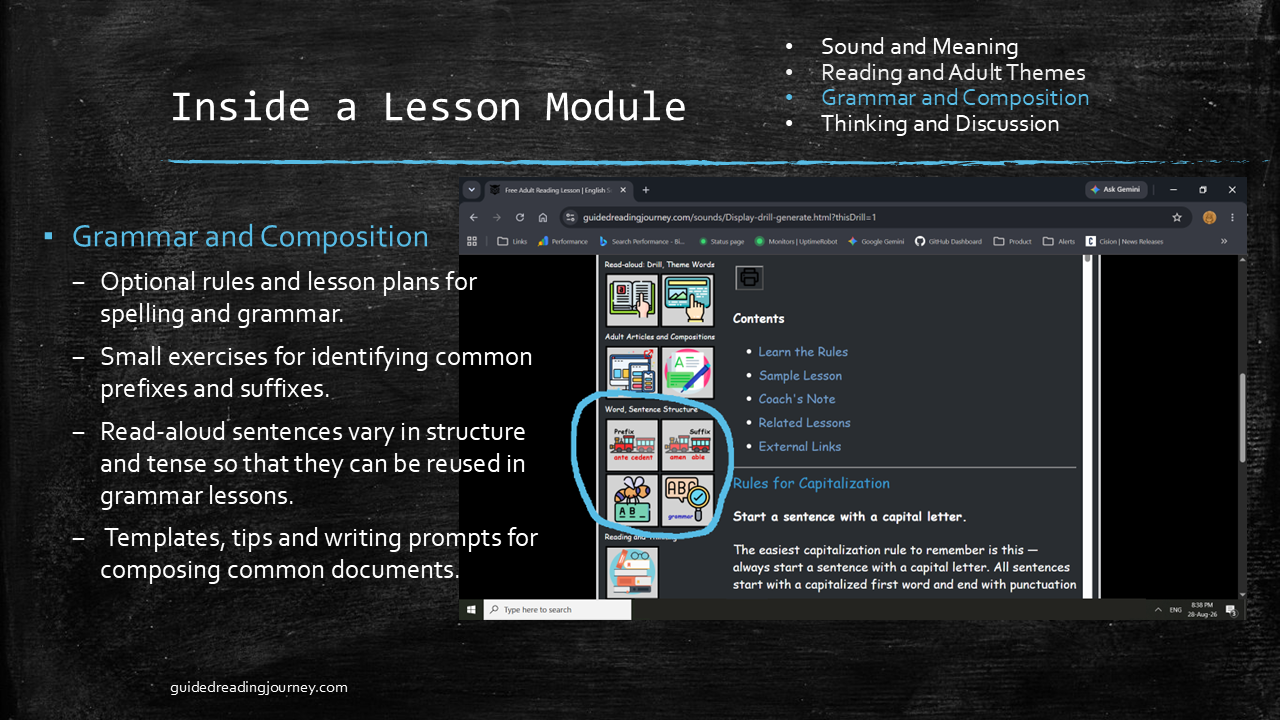
Spelling lessons, along with activities using prefixes and suffixes, give learners a chance to take words apart and see how they are formed.
We can do much the same thing with sentences. Those read-aloud sentences we've already used for reading practice can come back again — but this time we can examine them. Where is the subject? Where is the verb? What happens if we change the tense? How is the sentence constructed?
Then we can move from analysing writing to actually doing some writing.
Composition templates introduce familiar kinds of documents and show how they're organized. The compositions included with the drills can become examples, and learners can use the corresponding templates to create something of their own. So we're reusing the same material in a new way: first learning the words, then reading them, then examining how language works, and finally using it to write.